Are you defined by the number on the scale? Society has conditioned us to be hyperaware of the number on the scale. It has been ingrained in us that the number matters. Society tells us that this number needs to be at a certain value. We have our own personal beliefs about what this number should be. But why? Why do we feel this number is important? Why do we allow this number to define us? Why do we allow this number to drive our health behaviours? Why? Why? Why?
Although the title of this post is to ditch the scale I do realize that most people are not going to ditch the scale completely, at least not up front…but when it comes to your health and fitness goals the number on the scale CAN NOT be the only measure of progress. When you start with a personal trainer or start in a fitness facility you may have some sort of assessment which often involves stepping on some sort of scale. The scale is often the thing that jumpstarts a health and fitness journey for a lot of people…the scale is always going to be there…I’m not naive to that.
But I think it’s important to educate you on where scales can fall short and on other ways that you can track your health and fitness progress…because the scale is not the only way nor is it the answer to everyone’s struggle. I want you to stop and think about your health and fitness journey (no matter where you are in it)…consider how you have tracked progress. Often the first thing that jumps to most people’s minds is the scale but can you think of others ways outside of the scale? Here are some of my favourite ways to help clients track progress that don’t require fancy assessment equipment of any kind;
- Measurements – grab yourself an old fashioned tape measure and take your measurements. If you have a trainer who can do this for you or guide you through it great…but if not this is not a precise science. The key with measurements is to be consistent and take them in the same place each time, outside of that it doesn’t really matter where you take them. Measurements work whether you are trying to lose weight or gain weight and they will give a reflection of where you are in your journey.
- Consider how your clothes fit – have you slide on a piece of clothing and noticed it fitting differently? Start to tune in and be aware of these things. You may not notice this right away, but often over time you may begin to notice that when you put a particular piece of clothing on it is fitting differently. Again if you are striving to lose weight it may feel looser, and if you are looking to gain weight you may notice it start to feel tighter.
- Consider your energy levels – Do you feel more energetic when you are exercising consistently. This is often something that many people start to notice very early in their health and fitness journey and it’s a sign that you are making positive progress. Start to be aware of your energy levels each day as you progress on your health and fitness journey and you will likely notice that they are improving.
- Consider your sleep – Have you checked in with your sleep lately? Another thing that many people will notice when they start training consistently is an improvement in sleep. These changes may vary from one person to another but generally an improvement can be seen provided that there aren’t other things in your life interfering with your sleep.
- Overall mood and wellness – How do you feel overall? With regular exercise many people will find themselves feeling more energetic, in a more positive mood and just feeling better overall. Check in with how you are feeling…improvements in this area can generally be noticed fairly early on in your health and fitness journey.

Have I convinced you yet? No…then I want you to consider this. If you are determined to continue to use a scale I want you to ensure that this scale looks at more than just your body weight. These are the scales that you will often see in fitness facilities but you can now purchase these scale to use at home for relatively cheap (I have one personally that I purchased off Amazon for about 60 bucks). To keep the science simple here these scales require you to have placement (preferable directly, so take your socks off) with small electrodes on the scale that will use an electrical current to give you an estimation of things like body fat percentage, muscle mass, body water, ect. No these scales are not perfect but if you are using the same scale all the time, it will give you a picture over time.
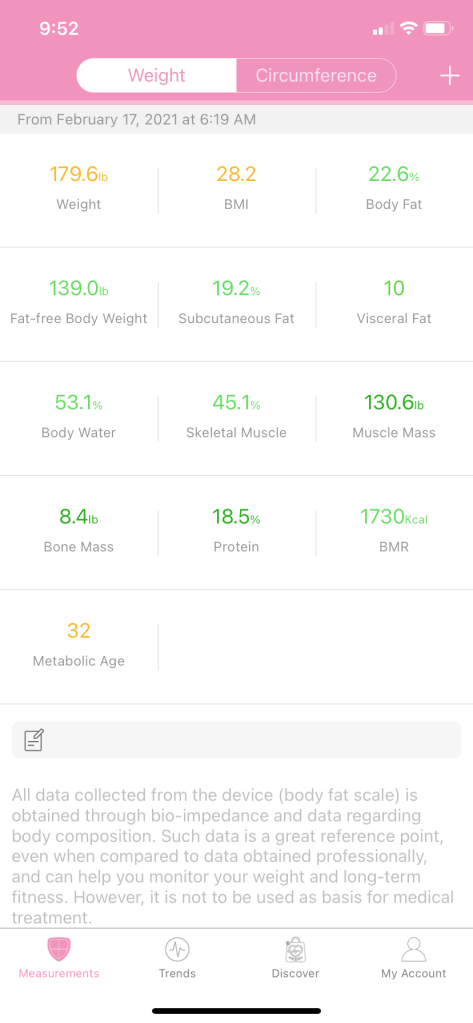
To illustrate exactly what I mean here and why it’s important to consider more than just the body weight I will use an example from my personal scale. The green colour indicates what’s considered average, the dark green colour is above average and the yellow numbers are considered a needs improvement area. Looking at the image you can see that for me personally my body weight which can fluctuate about 2-3 pounds a day when taken first thing in the morning and my BMI are considered are area for improvement. However, looking at the remaining areas like body fat percentages, muscle mass and bone mass values they are all falling in a green or dark green colour. Have I convinced you now? Consider the fact that just a regular scale that is just giving you your body weight may result in concern with body weight as would be illustrated here with my personal numbers. But when I look at my percent body fat and muscle mass measures I’m not concerned. As a side note; this is why BMI can also be an inaccurate indication of health in SOME CASES. I want to be clear that this is not always true, but if you are falling into a “overweight” BMI category it may be worth exploring your body composition before writing it off completely.
When you embark on a fitness journey it’s important to consider more than just the number on the scale. If you aren’t ready to break up with the scale for good then be sure to add other measurement and assessment tools into your routine. These tools don’t have to cost you anything and they don’t need to be time consuming to gather but consider how you feel and consider other aspects of your health and fitness. Weight is not a deal breaker and does not always tell the whole story!
 ashleepedlowcoaching.ca