
Diastasis Recti…have you heard of it? Chances are if you are pregnant, have been pregnant or have done any research at all into pregnancy you’ve heard of it. Diastasis Recti has been given a bad rapport. Once women learn what it is, they spend a lot of time trying to prevent it from happening to them. But I’m going to tell you this…it is necessary and it happens in almost ALL pregnancies.
Diastasis Recti has been defined as the gap between the two sides of the rectus abdominis muscle (this is your 6 pack muscle). The connective tissue that joins the two sides of the 6 pack muscle is called the linea alba. The linea alba is a connective tissue that softens and becomes more lax during pregnancy. But why does this happen? Well…the simple answer is that baby needs to grow. As your baby and belly grow this connective tissue moves wider apart to allow the abdominal wall to expand. This separation is normal, natural and happens to almost all women so there’s no need to panic or worry. Usually this separation is seen in the third trimester and persists into the postpartum period. In the postpartum some women will find that their disastasis recti will heal without intervention as long as there’s no additional stress or aggravation placed on the abdominals and the linea alba. Other women may still have a wide separation 8 or more weeks after delivery, some may still be healing at 6 months and some may be still healing after a year. Generally, spontaneous healing will occur over the first 6-8 weeks postpartum. If it is still persistent after 8 weeks intentional rehab strategies may be required.
Although a lot of the focus has been on closing the gap recent research has found that closing the gap is less important than regaining tension in the linea alba. The tension (or density) of the linea alba can be determined by considering how far into your abdomen you can press along the linea alba.

The biggest concern with regards to diastasis recti and exercise is coning or doming that may occur in the belly. Coning results when pressure in the abdomen isn’t managed well (because of weakness in the abdominals and linea alba) and the abdominal contents push against the weakened linea alba causing a cone or dome looking shape down the middle of the abdomen. If you notice coning with a particular exercise you should stop the exercise, however it doesn’t mean that you can never do that exercise again. Once you have reconnected to your core and are able to manage the pressure in your abdomen you will likely be able to return to that exercise.
You can assess yourself for a diastasis although if you are concerned about your diastasis reaching out to a pelvic floor physiotherapist is a great option. When assessing yourself for a diastasis having a measure from pre-pregnancy is ideal to use as a comparison, however it is not necessary.
To assess your diastasis;
- Lie down on back with knees bent and take some breaths
- Note if the skin over the abdomen is tight or loose
- Slowly lift your head and neck just off the floor (shoulders stay on the floor) and palpate the linea alba at the belly button, above the belly button and below the belly button
- Take a deep breath in and as your exhaling and drawing your pelvic floor up lift head and neck off the floor
- While doing this measure above the belly button, at the belly button and below the belly button
When measuring above and below the belly button be sure to use a consistent spot from one measurement to the next (3 fingers widths above and below is a good way to stay consistent). You can have someone else perform this assessment on you as well if you need to (if you see a pelvic health physiotherapistst they likely will). Ideally you want to maintain consistency from one assessment to the next when you assessing for diastasis so aim to assess in the same spots and mark them before measuring if you need to.
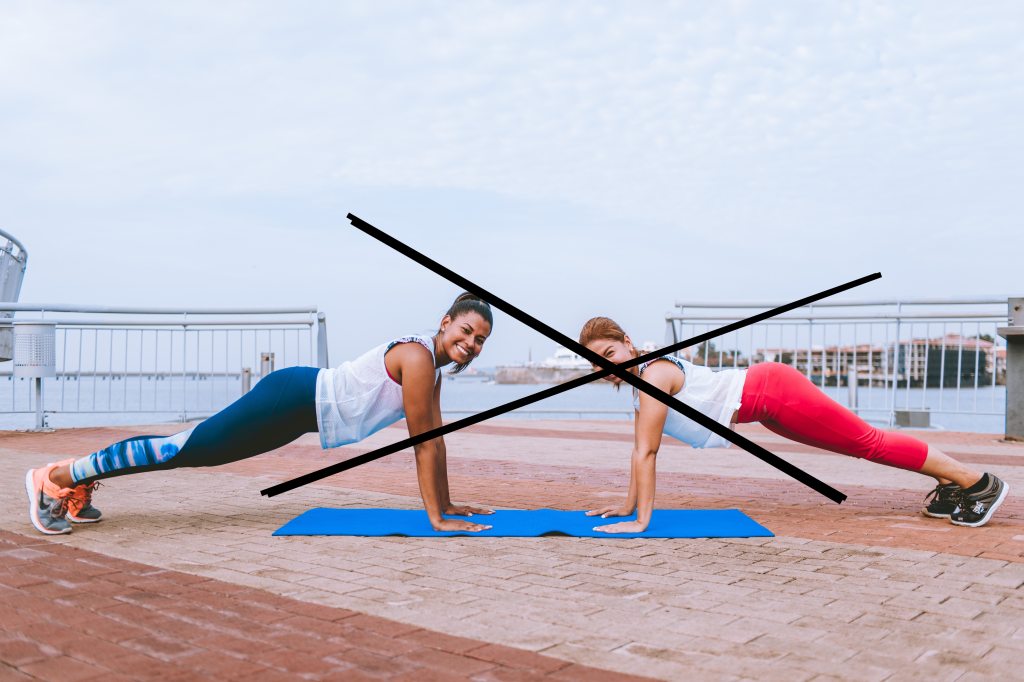
When it comes to exercise with a diastasis in the postpartum period we want to focus on regaining strength and re-connecting to the core. Starting with your connection breath is the most ideal way to do this (click here to learn how to do the connection breath). While your diastasis is healing avoid exercises that place a lot of stress on the abdominal wall, plyometric exercises and intense exercises (this includes exercise classes). Avoid exercises where may experience a bulge in the lower belly like crunches, sit ups, leg raises, bicycles as well as exercises where your belly is hanging towards the floor (planks, pushups, ect). Stop exercise if you are experiencing any pain, there’s a pulling sensation on your C-section scar, you feel pressure in your bladder or rectum, you are leaking urine or you can’t breathe easily.
Remember that when it comes to diastisis recti you are not broken and you are not alone. Many women will have the same or similar experiences that you do. It’s also important to remember that you can heal by re-establishing efficient management on pressure in the abdomen as well as improving abdominal strength. Pelvic health physiotherapists can also be very beneficial when you are suffering from a diastasis recti. Remember that you are not alone!
 ashleepedlowcoaching.ca