The health and fitness journey. Many of us have been on one at some point and time in our lives and maybe even for different reasons at different times. When most people start on a journey like this the goal is to overhaul everything all at once which is overwhelming and usually doesn’t work out well. So today, I’m sharing with you 6 tips to help set you up for success when you start out on this journey.

I want to start off by saying that you should always follow the advice of your health care provider when it comes to your preconception, pregnancy and postpartum health and fitness journey. The tips in this article are not intended to replace or overtake the advice of your health care provider. Also note that every woman’s preconception, pregnancy and postpartum journey is different so consider the advice of your health care provider when you are beginning to implement these tips into your lifestyle. Your journey is unique to you and may even look different with each baby. Give yourself grace and remember that your body is going through or has been through some dramatic changes on your journey to motherhood. If focusing on rest and recovery is what is best for you in the moment then come back to this article when the time is right for you.
Ive written these tips in the context of mommas or mommas-to-be, however these tips can be used by anyone and are easy to implement into just about any lifestyle so feel free to share this tips with all!
Tip 1: Think in Terms of Behaviours not Goals
Thinking in terms of behaviours instead of goals can be super effective at setting you up for success. While I don’t want to dismiss the importance of having long-term goals, these smaller behaviours can be incredibly effective and helpful in working towards those long-term goals. The key here is that you are choosing behaviours that are moving you towards your long-term goal. For example, if your long term goal is to increase your muscle and strength a behaviour might look like adding enough protein at dinner or strength training. Keep in mind that depending where you are in your motherhood journey your goals may change which means these behaviours may look different and may change throughout your preconception, pregnancy and postpartum phases of life. Focusing on these behaviours is going to be the base for the tips that follow, so be clear on your long-term goals and what behaviours are going to help you move towards those goals.

Tip 2: Think Short-Term instead of Long-Term
Going hand-in-hand with the above tip about behaviours we want to strive to think more short-term in our behaviours and goals instead of long-term. As I mentioned above, there is value in having long-term goals, but short-term goals/behaviours can help increase confidence and keep you motivated. These small weekly or biweekly goals will give you the opportunity to see yourself achieving milestones weekly instead of waiting a year (for example) to get to the final product. Short-term behaviours and goals help keep you accountable along the way and keep you moving towards your bigger goal.
Tip 3: Check Your Confidence Level

Now that you have some ideas about what your short-term beahviours are going to be you can check your confidence level in achieving these behaviours. This is a simple question you ask yourself. “On a scale of 1 (not confident at all) to 10 (100% confident), how confident am I that I can complete the behaviour I have chosen for the next 2 weeks?” Your answer should be an 8 or higher. If it is, GREAT, you just found your first small behaviour you will work on. If it’s not an 8 or higher I want you to look back at that behaviour and think of how you can make it even simpler. Many people don’t understand how simple I’m talking here so I want to give you an example. Let’s say your long-term goal is to build strength postpartum so that you can keep up with your kiddos. You set your first small behaviour as strength training 3 times per week. When you check your confidence level at implementing strength training into your week 3 times you get about a 4/10 because you’re busy. So, we re-evaluate. Maybe you think you can try 2 times per week, but that only gets you to a 6/10. What if I suggested that you pack your gym bag the night before or if you’re working at home you lay out your workout clothes and shoes. Could you do that? That you are 9/10 confident you can do. Then that’s where we start. I realize, that this may seem overly simplistic, however it will build confidence in you because you know that you can pack that gym bag, or lay your clothes out. Then after 2 weeks, maybe we move to starting to implement strength training. There may be times in this first couple of weeks where you do put your gym clothes on and do a workout, and that is great, however if you don’t you aren’t left beating yourself up about it. This is the most effective way to build SUSTAINABLE habits into your life. It does take time, but it will be something that you can continue to maintain for the rest of life, instead of a quick fix. Give it a try and you will start to see what I mean.
Tip 4: Check your Mindset

Many people do not truly understand how powerful your mind and your mindset are. The stories you tell yourself can shape outcomes in your life. When you repeatedly tell yourself you are not a “fit person” for example, you are more likely to become that. The concept of fixed versus growth mindset has been made popular by Carol Dweck who is a researcher at Stanford University. In a fixed mindset individuals believe that their abilities or talents are fixed traits while those with a growth mindset believe that these talents and abilities can be improved and developed through hard work and persistence. Those with a growth mindset look at setbacks as an opportunity to develop skills, learn from criticism and are inspired by others. Because of this, individuals with a growth mindset usually maximize their potential and see more success when trying to overcome challenges. So, ask yourself…do I have a fixed mindset around my health and fitness journey or a growth mindset? I could probably do a whole post diving more into this topic, so I’m going to leave it at this, but start to think about your mindset…do you look at things with a growth mindset? Or a fixed mindset?
Tip 5: Track your Habits/Behaviours
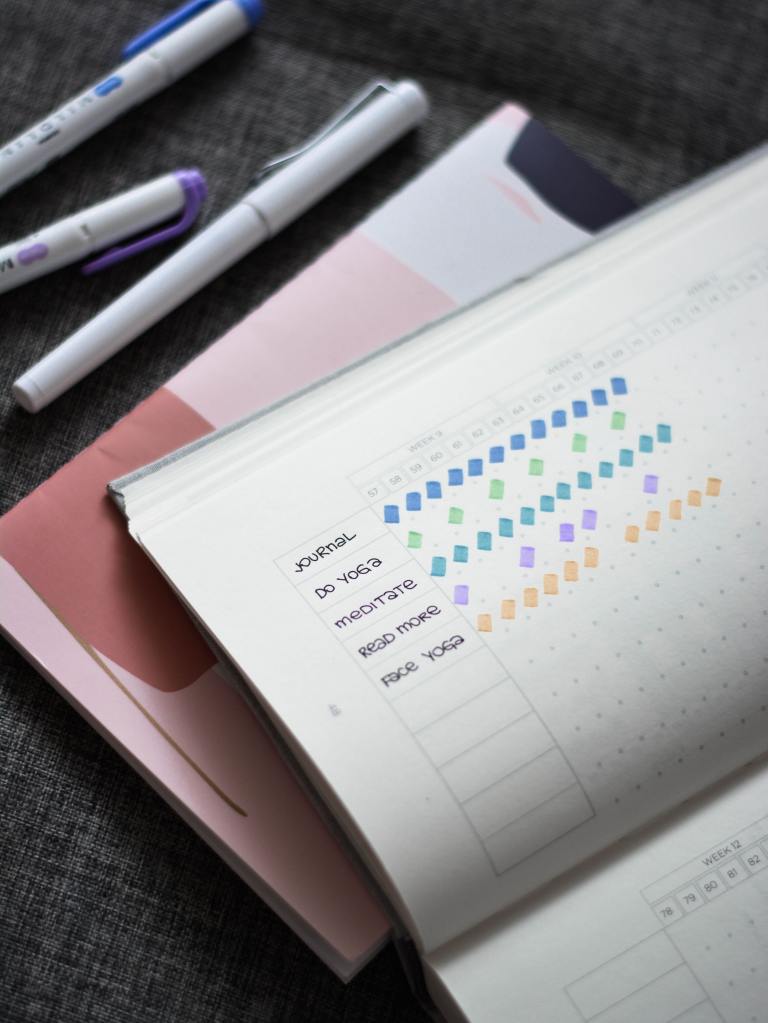
This tip may seem very simple, but you will be surprised how effective it can be. Once you know what the behaviours you are working on are track when you complete them and when you don’t. There are apps out there to track your habits and behaviours, but you can also do this with a simple notebook. When you write these things down you actually tend to stick to these behaviours more. When you look at how many times you’ve completed the behaviour in the last 2 weeks it will help you build confidence. It will also tell you if you need to back up and re-evaluate it. You want to aim for about an 80% success rate over a two week period. If you aren’t achieving the 80% then back up, and check your confidence level in that habit as mentioned above.
Tip 6: Adjust your Expectations
Social media and the internet tend to give us an unrealistic expectation of what our health and fitness journeys may look like. Remember that social media does not always show you the behind the scenes and you may be comparing yourself or setting your expectations based on someone else’s results who is in a completely different situation than you. That said, it does not mean that you aren’t able to achieve results, it just means that you need to look at your lifestyle and set your expectations based on that. It may take you longer to get to the same place or based on your lifestyle and the way you want to live your life, it may not be possible for you and that’s okay. When we set our expectations of our health and fitness journey it is important to consider our own lives and nothing else. Set your expectations based on what you can do, not what you have seen others do.

There you have it…my 6 tips for setting yourself up for success. During the preconception, pregnancy and postpartum phases your goals and behaviours may change but these tips and the concepts behind them remain the same. During your preconception phase of life you may be working at getting strong and healthy, during pregnancy you are usually in a maintenance phase and trying to make healthy decisions for a healthy baby. During postpartum you may be focusing on rest and recovery and then on building strength to keep up with those kiddos as they become more mobile. Whatever, the long-term goals are, giving yourself a solid foundation is key to success over the long-term and these tips will help give you a foundation.
As always jump over to Instagram or Facebook for daily content!
 ashleepedlowcoaching.ca